When sizing an off-grid solar system, the first question is usually, “How many panels and batteries do I need?” That feels like the natural place to start, but it is backwards.
Start with the loads. Before choosing a panel, battery, inverter, or charge controller, figure out what the system needs to power, how much energy it uses each day, and how much equipment may run at one time. Once those numbers are clear, the equipment choices start to make sense.What You’ll Learn
- Calculate daily energy by multiplying each appliance’s watts by its operating hours.
- Size the inverter for peak simultaneous loads and short motor startup surges.
- Use autonomy and 80% usable lithium capacity to calculate battery bank size.
- Design the solar array around winter peak sun hours and real-world losses.
Table of Contents
- Define What Your Off-Grid System Needs to Do
- Step 1: Calculate Daily Energy Usage
- Step 2: Size the Battery Bank for Daily Use and Autonomy
- Step 3: Size the Solar Array to Recharge the Battery Bank
- Why Location and Season Matter So Much
- A Simple Off-Grid Solar Sizing Checklist
Define What Your Off-Grid System Needs to Do
A system for a full-time home is not designed the same way as one for a seasonal cabin, shed, workshop, or occasional-use property. Usage patterns matter just as much as appliance ratings.
Begin by defining:
- What the system will power
- When the property will be used
- Which loads run during the day versus at night
- Whether the system must operate year-round
- How long it should run through poor solar conditions
This establishes the goal before any products enter the conversation. A reliable off-grid system is built around actual energy demand, battery storage needs, location, and the toughest solar month, not around a shopping list that happens to look good on paper.
Step 1: Calculate Daily Energy Usage
Make a list of every electrical load the system will power. For each item, identify its running wattage and the number of hours it operates per day.
The basic calculation is simple:
Watts × hours per day = watt-hours per day
For example, a 150-watt refrigerator that runs efficiently for eight hours per day uses:
150 watts × 8 hours = 1,200 watt-hours per day
That is the same as 1.2 kilowatt-hours per day, since 1,000 watt-hours equals 1 kilowatt-hour.
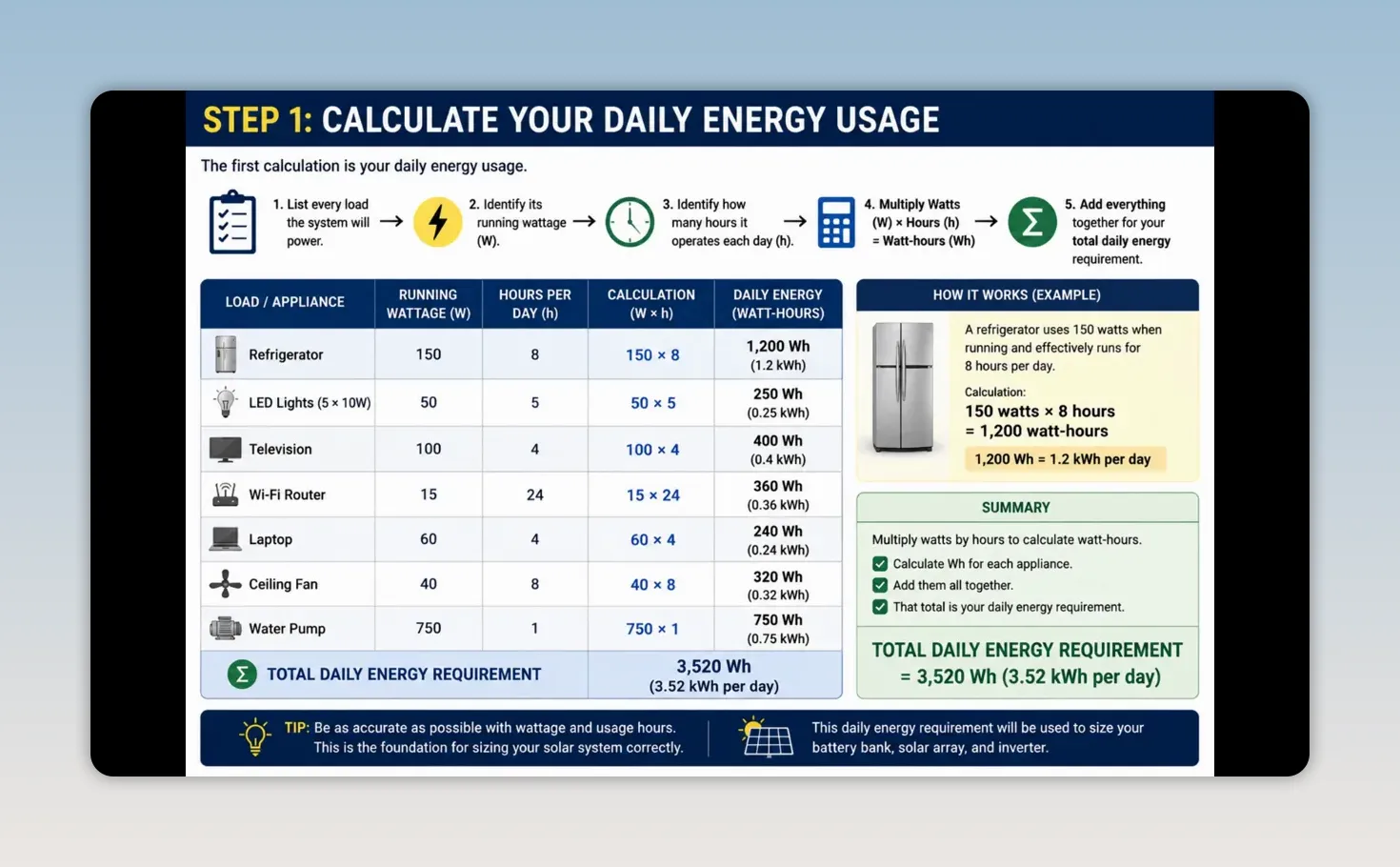
Repeat this calculation for every appliance, then add the results together. That total is your daily energy requirement.
For a simple example, suppose an off-grid home or cabin uses 20 kWh per day. That one number becomes the starting point for the battery bank, and then for the solar array.
Daily Energy Is Not the Same as Peak Power
Daily energy tells you how much electricity the system needs over time. It does not tell you how large the inverter needs to be.
For inverter sizing, calculate the loads that could operate at the same time. An air conditioner may already be running when the well pump starts, the refrigerator cycles on, and someone uses the microwave. Those overlapping loads determine the inverter’s required AC output.
You also need to account for startup surge. Equipment with motors, including air conditioners, well pumps, refrigerators, compressors, and power tools, can briefly draw two to six times their normal running wattage when starting.
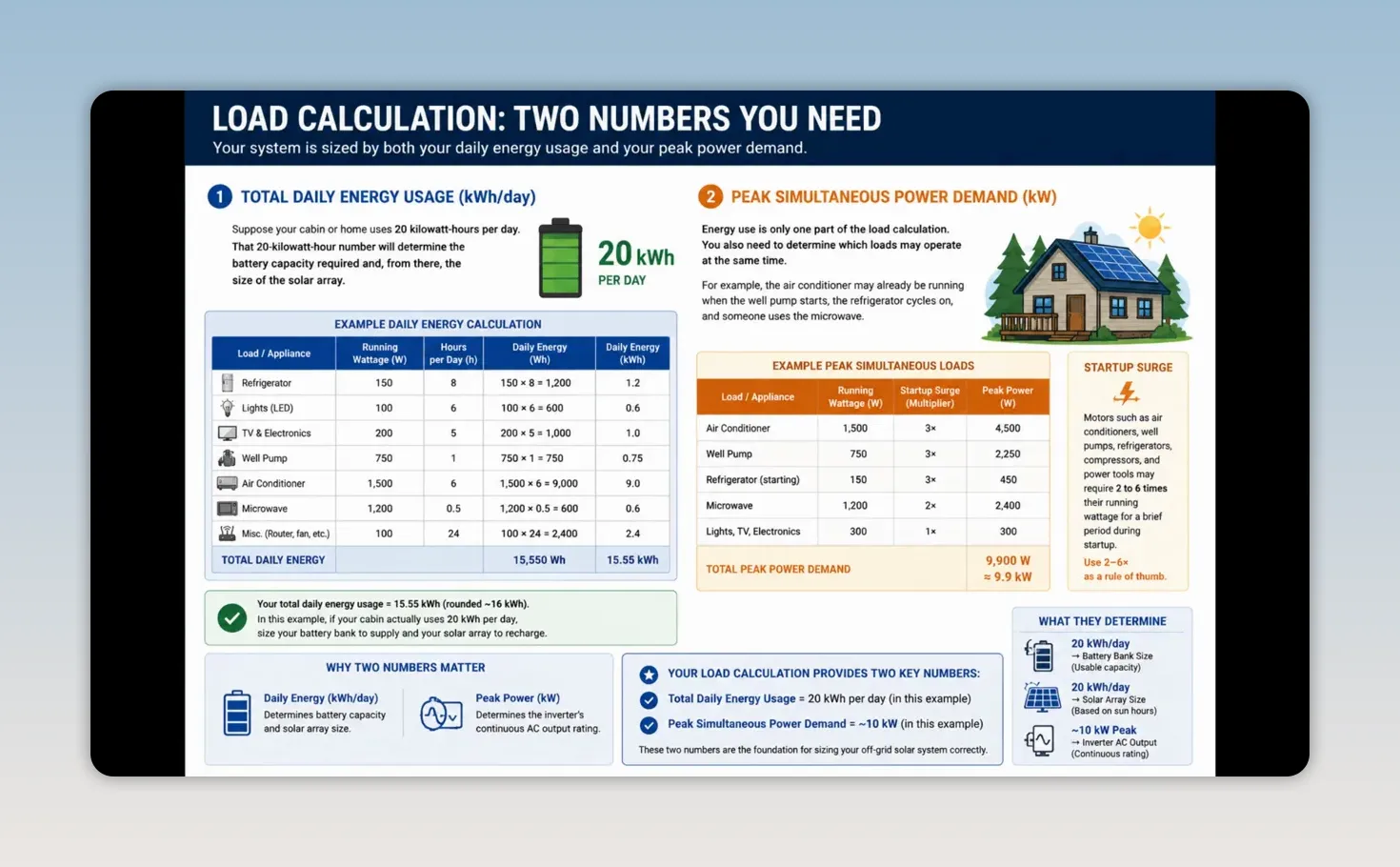
At the end of the load calculation, you should have two separate numbers:
- Total daily energy usage, measured in kilowatt-hours
- Peak simultaneous power demand, measured in kilowatts
The first helps size your batteries and solar array. The second helps size your inverter.
Step 2: Size the Battery Bank for Daily Use and Autonomy
Battery capacity depends on three things:
- Your daily energy use
- Your desired days of autonomy
- Your allowable depth of discharge
Days of autonomy means the amount of time the system can operate without receiving enough solar energy to recharge the batteries. More autonomy means more stored energy and a larger battery bank.
For lithium batteries, use 80% usable capacity in the planning calculation. This protects the battery from being designed around a full discharge.
One Day of Autonomy Example
Using the 20 kWh-per-day example with one day of autonomy:
20 kWh ÷ 0.80 = 25 kWh of battery capacity
That means the system needs a 25 kWh battery bank to supply 20 kWh of usable energy while staying within an 80% depth-of-discharge limit.
Two Days of Autonomy Example
If you need two days of autonomy, multiply the daily energy requirement by two before accounting for usable capacity:
20 kWh × 2 days ÷ 0.80 = 50 kWh of battery capacity
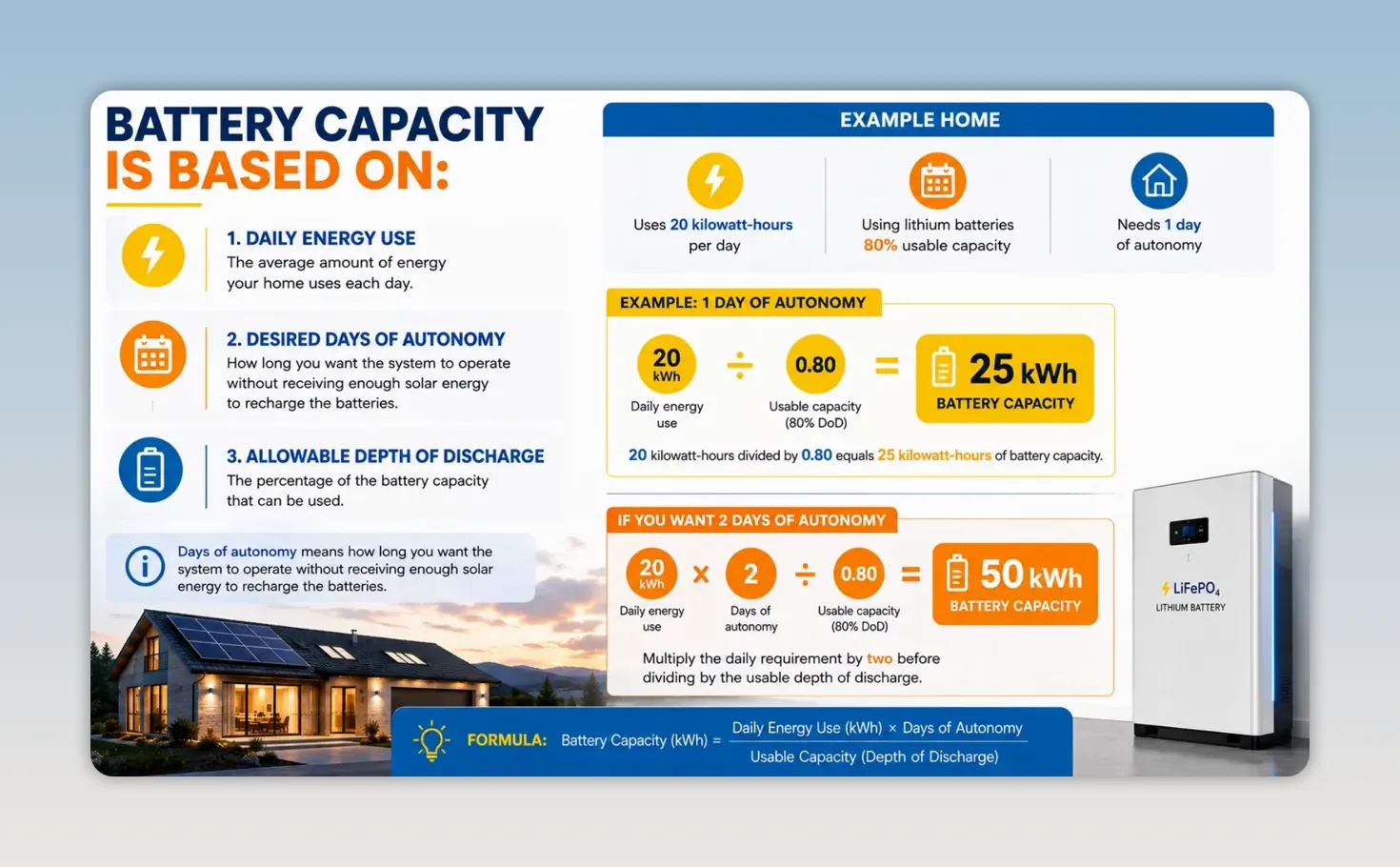
This does not mean the battery should be completely drained every day. It means the bank has enough total capacity to deliver the planned energy while remaining inside the intended depth-of-discharge limit.
The battery bank becomes the foundation for solar sizing because the array has to recharge that stored energy during the available solar production window.
Step 3: Size the Solar Array to Recharge the Battery Bank
Solar panels do not operate under ideal laboratory conditions every day. A practical off-grid solar array needs additional capacity to account for real-world losses and changing conditions, including:
- High panel temperatures
- Wire losses
- Battery charging losses
- Inverter and charge controller losses
- Dust and panel soiling
- Less-than-perfect panel angle or orientation
- Weather variation
- Lower-than-expected solar production
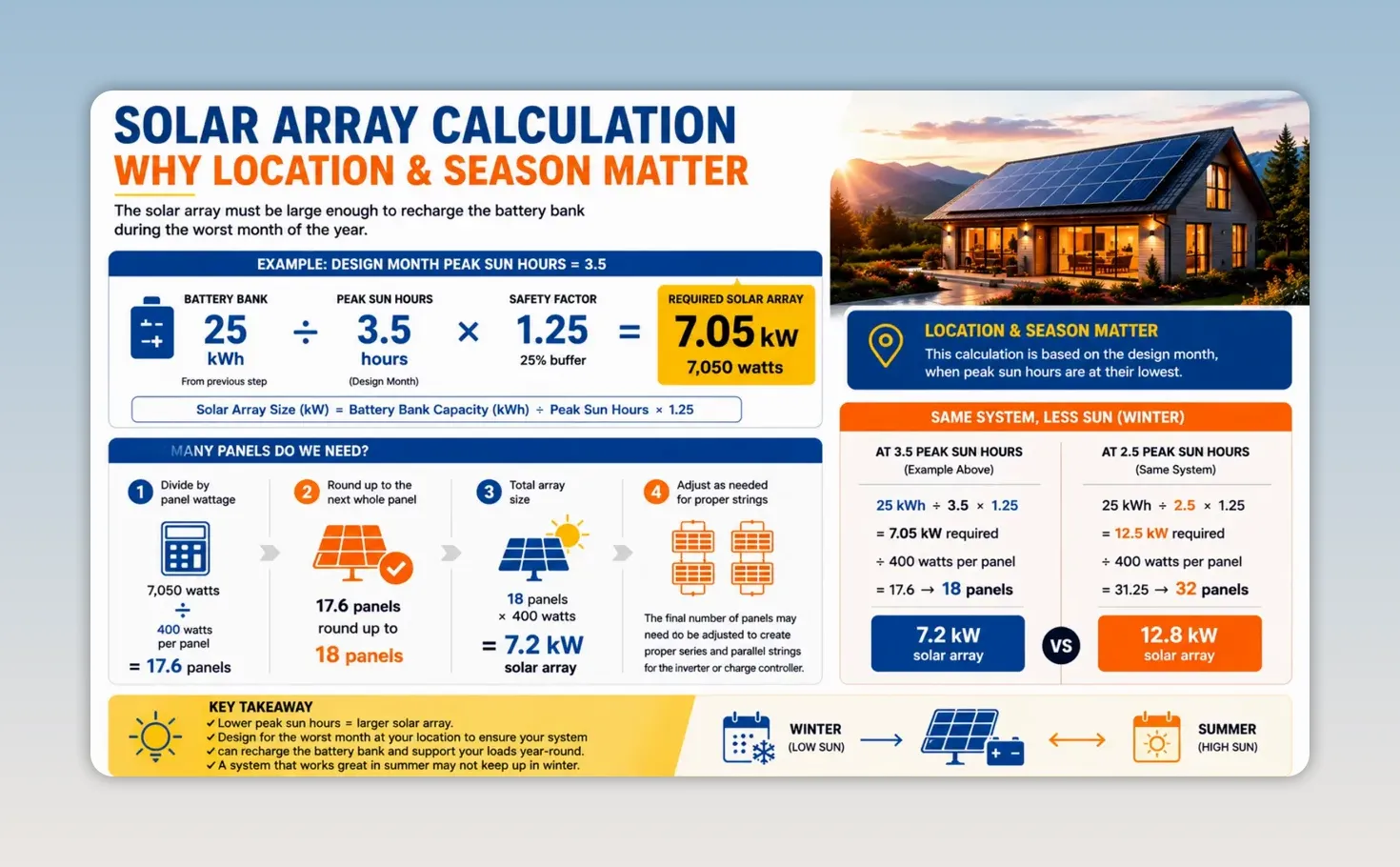
A useful design approach is to take the battery bank capacity, divide it by the design month’s peak sun hours, then apply a 1.25 safety factor for real-world conditions.
Solar array size = battery bank capacity ÷ design-month peak sun hours × 1.25
Peak sun hours are location-specific and seasonal. For local production estimates, tools such as NREL PVWatts can help identify solar resource differences throughout the year.
Converting Array Size Into a Panel Count
Suppose the required solar array is 7.05 kW and you are using 400-watt panels.
7.05 kW ÷ 400 W = 17.6 panels
You cannot install 0.6 of a panel, so round up. In this case, the system needs at least 18 panels.
18 panels × 400 W = 7.2 kW solar array
The final panel count may still need adjustment for proper series and parallel stringing with the selected inverter or charge controller. The electrical compatibility of the equipment matters, so do not treat panel count as the final design step.
Why Location and Season Matter So Much
The same loads and battery bank can require dramatically different solar arrays depending on the location and the time of year.
Consider a system installed where winter provides only 2.5 peak sun hours per day. With fewer productive hours, the array needs to be substantially larger to recharge the same battery capacity and support the same loads.
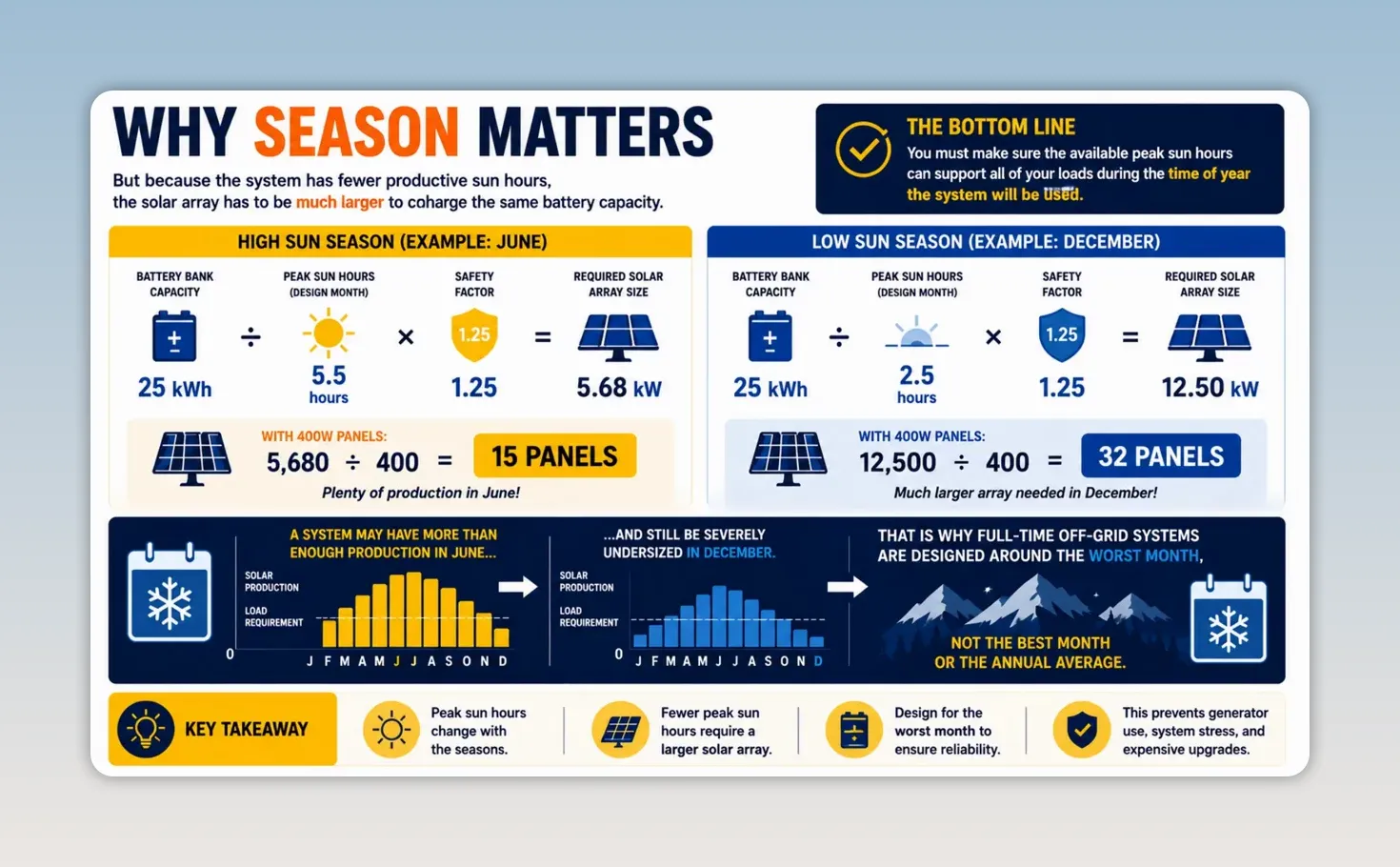
This is the point many off-grid designs miss. A system may have plenty of production in June and still struggle badly in December.
For a full-time off-grid home, design around the worst solar month, not the annual average and not the best month of the year. The available peak sun hours during the season when the system must operate need to support the loads and recharge the battery bank.
A Simple Off-Grid Solar Sizing Checklist
- Define system use. Identify whether you are powering a home, cabin, seasonal property, shed, or another type of load.
- List every electrical load. Calculate daily energy usage and peak simultaneous demand.
- Size the battery bank. Use daily consumption, desired autonomy, and usable battery capacity.
- Size the solar array. Use the battery capacity, design-month peak sun hours, and a 1.25 safety factor.
- Confirm equipment compatibility. Make sure panel strings, inverter capacity, charge controller limits, and battery requirements all work together.
Getting these calculations right at the beginning can help prevent expensive upgrades, extra generator runtime, and system redesigns later. The goal is not simply to build an off-grid system that works on a sunny summer day. The goal is to build one that remains reliable when conditions are at their most challenging.
Off-Grid Solar Sizing FAQ
Should I choose solar panels and batteries before calculating my loads?
No. Start by calculating daily energy use and peak simultaneous power demand, then choose equipment that meets those requirements.
What is the difference between kWh and kW in an off-grid solar system?
kWh measures energy used over time, which helps size batteries and solar panels. kW measures power demand at a given moment, which helps size the inverter.
How much battery capacity do I need for one day of autonomy?
Divide daily energy use by the usable battery capacity. With 20 kWh of daily use and 80% usable lithium capacity, the required battery bank is 25 kWh.
Why should an off-grid solar system be designed for winter?
Winter often has fewer peak sun hours. A system sized only for strong summer production may not generate enough energy to support loads and recharge batteries during the worst month.